
Stories
fun facts, useful bits of knowledge and interesting insights from my therapeutic work

In Psychotherapy and in Life Coahing we often deal with very serious topics - but the process can still be light, lively, and fun!
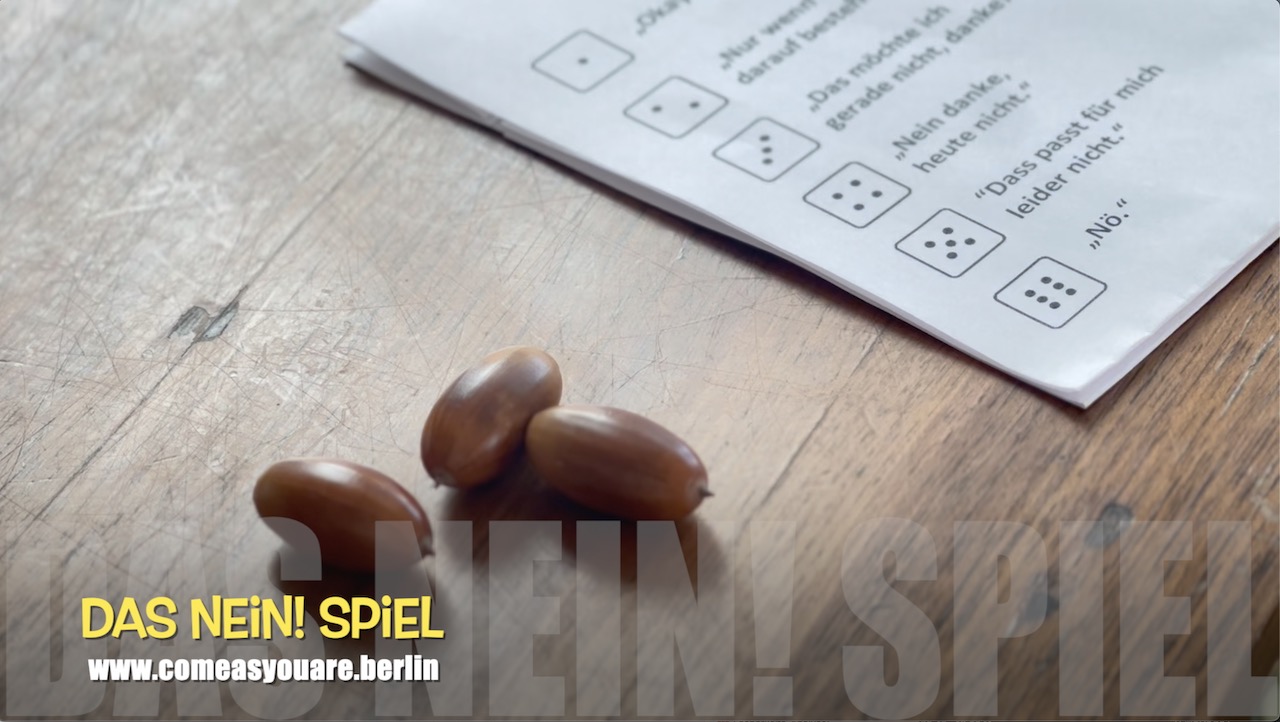
THE NO! GAME – a coaching game to learn and practice saying “no”
The video tutorial is at the bottom of this page!

More poetry, less drama – a therapeutic intervention
If you have been following Come as you are Berlin on Instagram or facebook, you may have noticed a series of posts with the title more poetry, less drama. At a first glance, it may seem natural that, in therapy, we deal with drama rather than with poetry!
Why is poetry important? How does it relate to psychotherapeutic work? What does it have to do with solution-oriented coaching?
If you have been through adverse situations or experiences, if you suffer from depressive episodes, or if you have family members or other important persons in your life who suffer from depressions, then you have most probably spent longer periods of time in an inner state of high alertness, in survival mode. Your nervous system is well trained to identify possible danger, adverse situations and damaging experiences – and to react so that they can be avoided, fended off, or survived with least damage possible.
What a great help it is to have a well-functioning nervous system, so well trained to protect us!
But sometimes, our nervous system gets overprotective: It can only see negativity, danger and difficulty all around.
If this is the case for you, then this means, simplified, that your right-side prefrontal cortex which is in charge of telling you “No! Stop! Careful!” has had much more work to do and therefore much more time to practice doing its job than the left-side prefrontal cortex, which is in charge of saying “Yes…! More…! Enjoy….” to you.
The alarmed, worried voice from the right side of your brain is so strong and loud, that the gentle, happy voice from the left side hardly gets a chance to be heard. There is a good reason for that – you needed that protective voice quite often in the past! But there are moments when you don´t need it. Moments in which it would be nice to tune in and listen to the happy, calm voice from the left side of your brain – to relax and enjoy the good moments of your life. If in your past you have hardly had a chance to allow this voice be heard, you might have forgotten how to tune in to it, how to listen to it.
It is as if you had trained only the muscles of one hand at the gym, lifting heavy weights with only the right hand, for years, and hardly ever using the left hand!
Good news: Exercise can bring things back into balance!
But how do you exercise your mind? By strengthening neural connections. In order to be able to enjoy life, to notice when life is safe and things are good, you need to start exercising your ability to hear the gentle murmur of your left-side prefrontal cortex.
How to do that?
For example, by paying attention, focusing on, taking a moment to acknowledge, appreciate and enjoy the things you like – the things that are good for you. Beauty, kindness, the moments of feeling safe, healthy, strong and calm, and in tune with yourself and the world. By allowing yourself to notice moments of poetry in your life. By saying to yourself – oh, yes, this is nice – and nodding a smile towards your left-side prefrontal cortex: Thank you for letting me notice this, buddy!
If you start exercising to perceive, acknowledge, name, appreciate and enjoy those good moments, you will soon notice that there are more and more of them coming into your life. This is the healing magic of strengthening new neuronal connections in your brain. What a magical tool our mind is!
To exercise a little bit every day, take a moment to tune in to the poetry, allow the drama of life to fade away for a while.
For inspiration on how to do this, check our posts on Instagram.
I wish you more poetry, less drama in your every day!
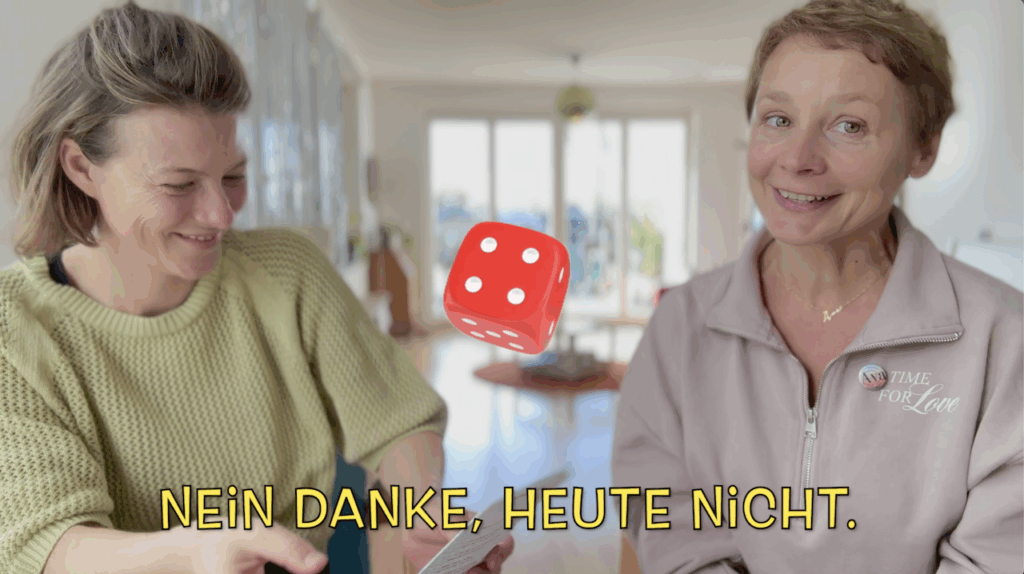
THE NO! GAME – a Coaching Game to learn und practice saying “no”
To help my clients learn to say “no” in a stress-free way and to integrate this skill playfully into their professional and family situations, I invented a dice game: THE NO! GAME. The game is suitable for ages 6 and up, and for two to six players. It can be played with family and friends or used in a professional setting for team building. The game is a lot of fun and very entertaining – and before you know it, you will have playfully acquired some important strategies for everyday life!
Often, one of the things people who seek my help are struggling with, is saying “no” in a way which would feel right, appropriate and stress-free. They worry that the other person, be it a family member or someone from their professional setting, might feel offended, rejected, or upset by their refusal. They hesitate for so long that they themselves become annoyed, defensive, and harsh — and miss the attitude they had strived for. Or they struggle to find the right moment and the right way to say “no”, to articulate it in a way that would feel in line with their values and personality. Some people question whether they even have the right to say “no” in a particular situation or to a certain person. Many remain uncomfortable and insecure about saying “no”, and they worry that others are irritated with their inability to articulate a clear “no”.
Another aspect of being able to say “no” is the important ability to accept another person saying “no” to ourselves with ease and respect. It is interesting to watch this in children: they are usually really good at saying “no” — the younger they are, the more natural it comes to them. What children struggle with, however, is accepting a “no” from someone else. And it’s not just children; we adults don’t always find it easy either to accept a refusal and stay relaxed!
Good news: Being comfortable with the fact that, at any time, another person could, may — and, a some point, will — say “no” to one of our demands or requests is another skill that can be playfully acquired and practiced by playing THE NO! GAME.
In the game, we experience that a refusal can be many different things — most of them quite far from being a personal affront or a disregard for our needs. We don’t have to take a “no” personally. We develop the ability to feel comfortable and secure when facing refusal. This contributes to stress reduction and allows us to navigate our professional and family lives with greater ease.
What do you need to play THE NO! GAME ? A playing dice, some small items that can serve as game tokens – for example, coins, buttons, nuts or beans – and the Game Instructions with the List of Questions, which you can download here on Christmas Day!

The Inner Team – who’s inside you?
In our minds, we carry a plurality of thoughts at all times. Different personality traits inside of us are in charge of different opinions and points of view. This versatility of thinking enables us to consider a spectrum of possibilities and to view a situation from various perspectives at any given moment. Often, we don’t even realize that a kind of multivocal consultation is taking place within our minds; the versatility of our thinking is familiar to us.
Sometimes, however, it feels as if we are being pulled in different directions by conflicting voices inside our minds. A confusion arises, an inner conflict. Instead of chosing a line of action, we freeze in indecision.
Working with the Inner Team is a wonderful tool that enables you to adress inner conflicts, find your way out of indecisiveness – and to find more self-confidence and self-assurance!
Who’s in Charge?
First of all, it’s good to know that your Inner Team needs a Team Leader. That Team Leader is you! Your role is to invite all your relevant thoughts and oppinions into the discussion, to create space for everyone, and to moderate the conversation — everyone may voice their opinions and concerns. But ultimately, you will be the voice that makes the decision! Therefore, the first step is to identify yourself firmly as the Team Leader. Then, ask yourself: What’s going on here? What’s the problem? What’s at stake? What is the discussion all about? Once you’ve clearly defined the problem, you can write it down to keep it in focus. Then, as the Team Leader, you can invite all the thoughts and opinions that contribute a valid perspective on this issue. There is no need to keep anyone out of the conversation: every relevant thought is welcome, no matter how subversive or oposing it may be.
Identify Team Members.
The loudest voices speak up first! They want the most space for themselves and might even try to keep others away from the conversation. As the Team Leader, imagine yourself at a round table or on a stage, creating an equal space for all thoughts: For the big and loud ones, and for the quiet and small ones too. For the positive and constructive ones, and for the negative and subversive ones as well. When a thought speaks up, for example: We need to excercise every day! — you identify them, write down their name and their core message on a piece of paper, maybe even make a little drawing of them: “Aha, there you are, and this is your core message: We need to to excercise. I’ll call you by this name for now: The ambitious coach. I hear you, I see you, now please take a seat and wait a moment. Who else is here?”
Gradually, different parts of our thinking process emerge, some of them with more urgency, others reluctant or sulking, anticipating rejection from the rest of the team. It’s important to give each of the thoughts a space in the conversation; to give them a temporary name and note their core message, so that an inclusive environment is created with the notion that every opinion will be heard. At the end, listen in and ask – is there anyone else? Does anyone else have something to contribute? Sometimes the most important thoughts are those that hide in the background and only show themselves at the very end!
Now you have your Inner Team members gathered up and the consultation can begin.
Moderated Discussion
Next, the Team Leader’s task is to listen to everyone and ask good questions in order to shed light on the underlying issues. Sometimes, different alliances form between different lines of thoughts, or there are saboteurs who obstruct others. Quite often, these seemingly troublesome thoughts who seem to get in the way of the process actually have an important protective function. If you treat them with respect and acknowledge that their opinion matters, important insights may come to light — it often turns out that those obstructive thoughts or opinions are fulfilling an important role, or have fulfilled one in past life situations. There are various strategies for reintegrating these dissenting team members into the process and keeping the colaborative thought process in flow.
Conclusion
After all thoughts have been expressed, discussions between different voices and their opinions held, either an agreement may be reached, or the Team Leader proposes a compromise. If differing opinions from an oposing minority persist, they are acknowledged and validated with the promise that they will not be forgotten, and a concrete frame is given where those concerns can be adressed another time.
At the very end of the discussion, the Team Leader thanks everyone for their participation and engagement.

Work-Life Flow
When it comes to quality of life and stress management, the term work-life balance is frequently used, be it in life coaching or career counseling. What this term implies is that it is possible – and desirable – to attain a perfect equlibrium between two very different and separate realms of our life.
In my opinion, this expression is not helpful for several reasons. Firstly, it creates the impression that work and life are two antagonists, as if work was not a part of life – and as if life only truly existed outside of work. But many people cherish work as a very valuable part of everyday life. Quite a few people find joy, meaning, and purpose in their work, as well as the possibility to develop their potential, explore different relationships, and grow as individuals. For many, work is an essential part of a fulfilling and happy life.
Secondly, the word “balance” suggests that these two incompatible antagonists can be brought into a perfect state of equilibrium if only we invest enought time into training or mindfulness. As if we should be striving for something perfectly balanced, immobile, and final. But we are constantly in motion; it lies in the true nature of being human that we keep moving, changing and developing, just as our living conditions do, or our work environment, as well as our needs, values, wishes, opinions, and dreams. A lasting perfect balance implies stagnation, immobility — for a living human, this is neither desirable nor achievable.
Based on my work as therapist and coach, my observations, and my own life experience, I decided to develop a different terminology — and a different attitude towards this topic: the Work-Life Flow.
The Work-Life Flow implies that the professional and the private experiences of our daily life are in lively exchange and interaction. All those experiences are integral to who we are. This understanding of work and private experiences as being in connection and exchange also implies that we are free and able to use, apply, and further advance the special skills, abilities, and resources we develop through our experiences at work in our personal experiences – and vice versa. This can be particularly important for parents, for example, because in their relationships with their children, they may develop communication and leadership skills which they can effectively apply at work. Conversely, we may apply our professional skills in our private lives.
During the periods when we are dealing with an important topic in life – for example, communication, partnership, separation and loss, or the search for meaning – especially during those times the very possibility of encountering the questions surrounding this big topic in different contexts of our daily experience can make a change of perspective possible, which in turn may reveal new possibilities, paths and solutions.
Work experiences and private experiences are like the two blades of a kayak paddle. If we only paddle on one side, we move in circles and hardly make any progress. Keeping the kayak in perfect balance is impossible – the river never stands still, we have to keep moving. But if we paddle using both blades, creating a flow, an exchange, it is up to us to decide where we want to go, and how fast we want to get there! If we find a good flow, we can navigate pretty well even the most exciting currents and swirls.
Many of my clients love their work, but are still unhappy or lacking satisfaction and wonder what techniques could lead them towards a better work-life balance. Instead of striving for the perfect equilibrium, I support my clients in creating a good flow, a vibrant inner connection between their work and private lives – and thus perhaps not a perfect balance, but rather a greater vitality, joy, and flexibility in all areas of life.
On the other hand, there are also people who struggle with their jobs. When it becomes clear that a good flow cannot be achieved in a particular work environment, this could be a sign to look for other options. Through life coaching, a person can then sharpen their awareness of what kind of work experiences would best suit their personal work-life flow.